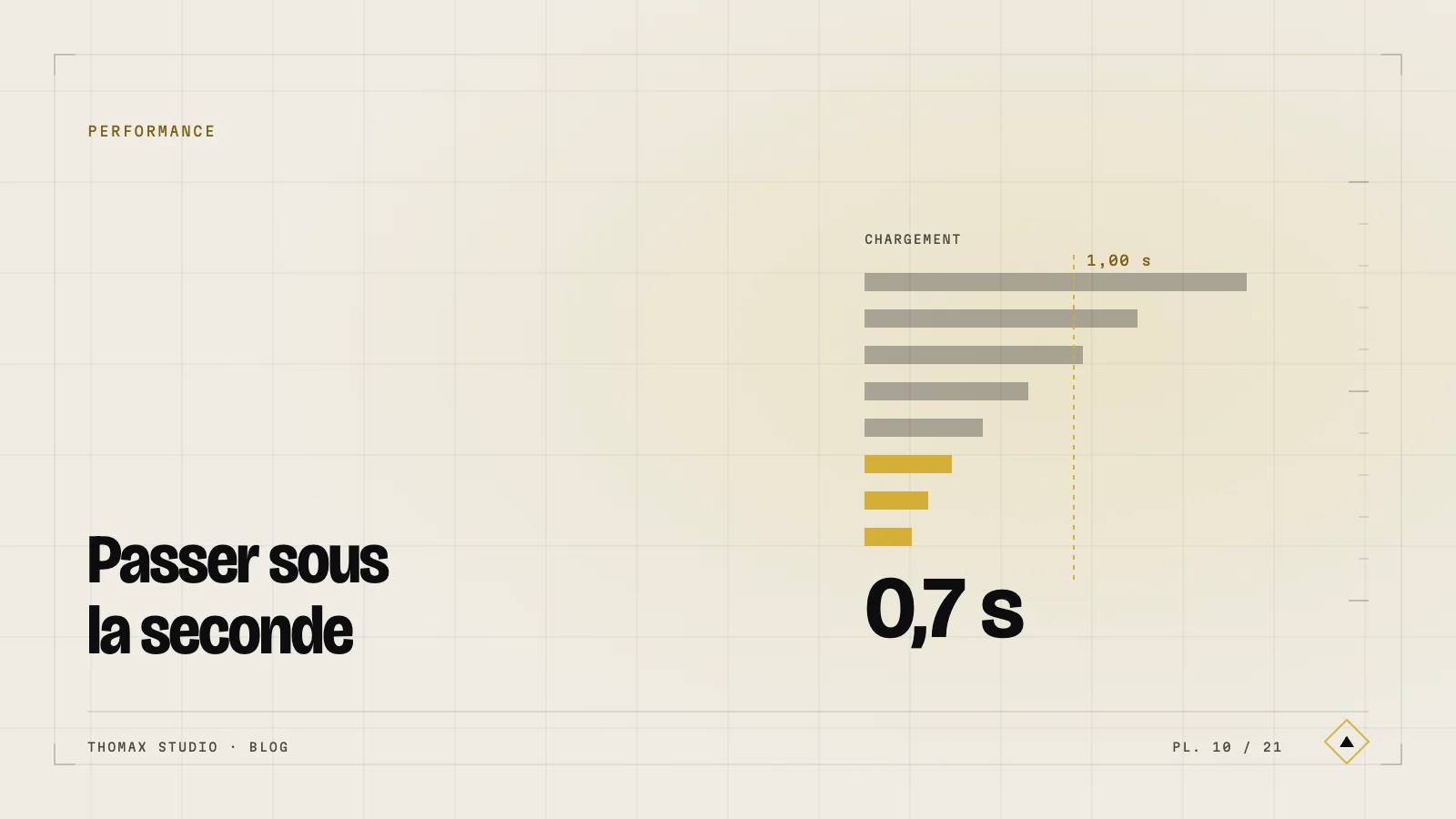
When a site goes past 2.5 seconds on LCP (Largest Contentful Paint), 40% of visitors leave before they have seen the first screen. For a premium brand that is unacceptable. And yet across the 47 technical audits we ran in 2025, the median LCP was 3.9 seconds.
Here are the three causes we find in nine cases out of ten.
1. Unoptimised JPEG and PNG images
The hero image on a home page averages 2.3 MB as a badly compressed JPEG. The same visual result in compressed AVIF weighs 180 KB. Thirteen times lighter, with no perceptible loss of quality.
The rule: no image above 300 KB, AVIF first with WebP as a fallback, exact dimensions served by the server, native lazy-loading below the fold.
2. Render-blocking JavaScript
Every third-party script — Google Tag Manager, Hotjar, Intercom, Crisp — adds around 80 ms to load time. Five scripts is 400 ms lost on LCP. Most sites load twelve.
The audit comes down to this: judge every tag on the value it actually returns, defer or async anything not critical to first paint, and move server-side whatever can move.
3. Basic shared hosting
Classic shared hosting returns the first byte in 800–1,200 ms. Vercel, Cloudflare or Netlify: 50–100 ms. That single metric hands back more than a second.
For a marketing site, edge hosting on a multi-region CDN is no longer a luxury — it is the baseline.
The result in practice
One of our watchmaking clients went from a 4.2 s LCP to 0.8 s in two weeks. Conversion: +38 %. Organic traffic over six months: +312 %. Performance is not a technical subject — it is a commercial lever.