“What does a website cost?” is the trap question par excellence. The honest answer — “it depends” — helps nobody. So here is a real price grid for the French premium market in 2026, by project type, with what actually moves the needle on a quote. The aim: that you can read a proposal, spot a price too good to be true, and decide with your eyes open.
The three families of project
Before the figures, you have to frame what is being bought. A website is not a commodity: between a template installed in two days and a bespoke platform built to convert, there is a factor of ten. Three families cover most high-end B2B needs.
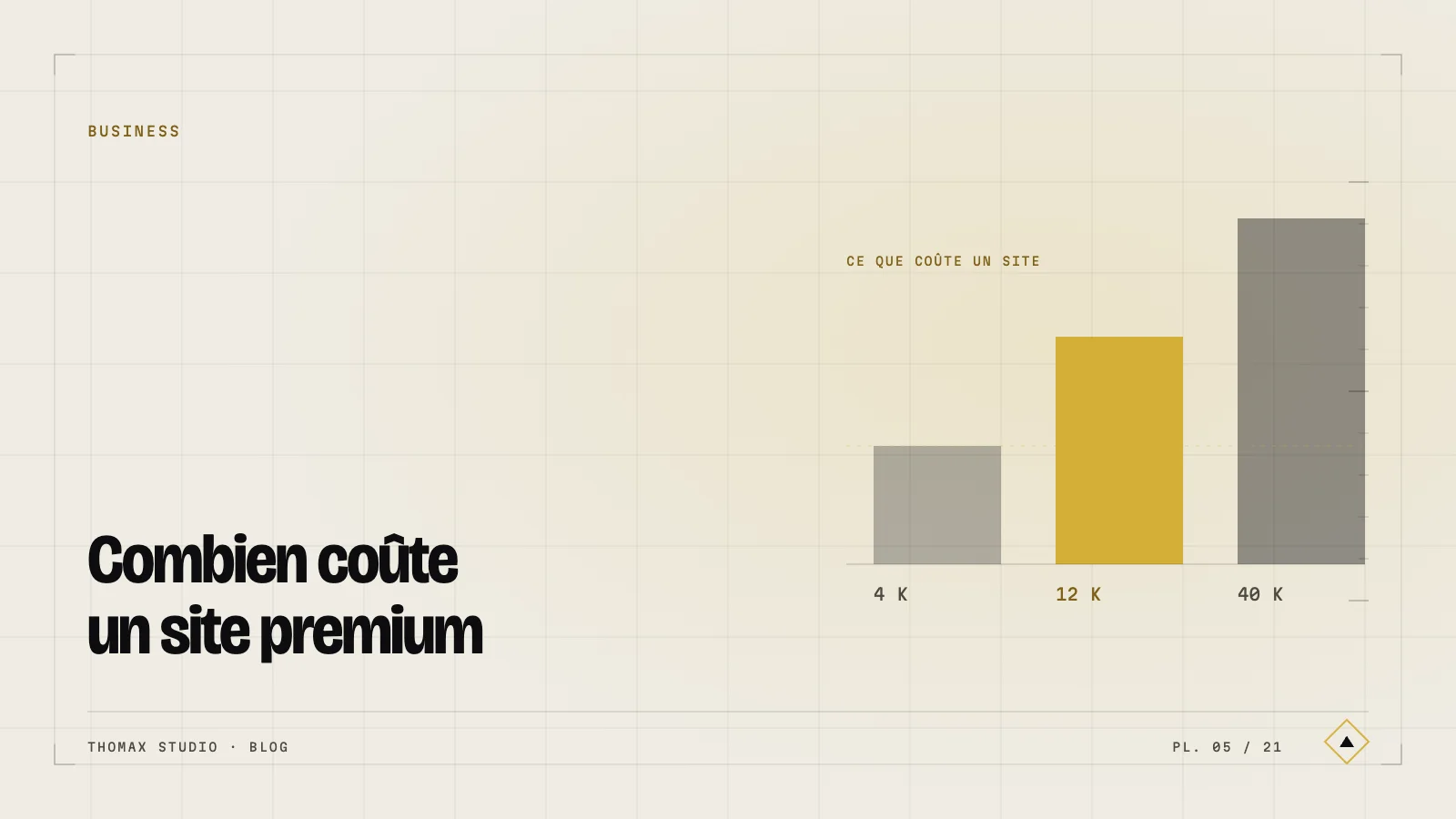
- Premium showcase site — €4,000 to €8,000. Five to ten pages, careful design, controlled animation, foundational SEO, a contact form. The brand already exists; you are giving it a credible, fast presence.
- Bespoke site — €8,000 to €25,000. Its own art direction, hand-built components, integrations (CRM, scheduling, a light client area), deep technical SEO, considered copywriting. This is the company’s central commercial tool.
- Premium e-commerce / Shopify — €12,000 to €40,000. Catalogue, payment, logistics, stock, marketing automation, sometimes a fully custom Shopify theme or a headless build. The price climbs with the number of products and the complexity of the selling rules.
These ranges are honest starting points, not ceilings. A bespoke project with multiple languages, a member area and a dashboard passes €30,000 quickly. Conversely, a tightly scoped showcase can come in under €4,000 — rarely while keeping a premium standard.
What actually moves the quote
Two quotes for “a showcase site” can read €4,000 and €9,000 without either lying. The difference sits in specific trade-offs, almost always invisible to an untrained eye.
- Bespoke design versus template. The single biggest line. An adjusted template costs a day; an original art direction, from wireframe to final mock-ups, costs five to fifteen. It is also what separates a site that does the job from a site that establishes a brand.
- The number of pages and templates. What counts is not the number of pages but the number of unique layouts. Ten pages built on two templates cost less than five pages all different.
- Integrations. Wiring in a CRM, a booking tool, payments, a newsletter or a client area turns a site into a system. Every connection adds development, testing and maintenance.
- SEO and performance. A site that is fast, structured, properly marked up and built for search represents real technical work — often 15 to 25% of the budget, and the most profitable line in the long run.
- Content. Copy, photography, video, illustration. When the client does not supply them the agency produces them, and that is billed. Considered content is also what converts.
A serious quote itemises these lines. A quote that gives one global figure with no breakdown usually hides either a template dressed as bespoke, or hours that will explode along the way.
Why the cheapest costs the most
The €1,500 offer exists. It is even appealing when you are starting out. The problem is not the price: it is what you cannot see in it, and what gets paid later.
- The premature rebuild. A rushed site ages in eighteen months. You rebuild it and pay twice: for the cheap site, then for the real one. “Cheap” becomes a deposit on a larger expense.
- Lost conversion. A slow, confusing or unconvincing site drives qualified prospects away. For a premium brand, one lost visitor is often worth more than the entire difference between quotes. The shortfall is invisible but entirely real.
- Technical debt. Fragile code, unmaintained dependencies, a structure that cannot evolve. Every change becomes a project. After a year nobody wants to touch the site, not even the person who built it.
- Image. In luxury and high-end B2B the site is often the first contact. A cheap site signals, in a second, a company that treats itself cheaply.
So the right question is not “what does it cost?” but “what does it return, and what would it cost me not to do it properly?”. A €12,000 site that brings in three contracts a year pays for itself in weeks.
Reading a quote properly
A quote is not just a price: it is a promise of method. Here is what to look at before signing.
- The breakdown by line. Design, development, SEO, content and integrations should appear separately. If everything is folded into one line, ask for the detail.
- The exact scope. How many pages, how many rounds of revision, who supplies the content, who hosts. Contractual vagueness always turns into overspend or frustration.
- Life after delivery. Maintenance, hosting, updates, training. A site is alive; a quote that stops at launch forgets half the life cycle.
- Ownership. Code, accounts, domain names, access. You should own all of it. A supplier who keeps the keys holds you hostage.
Be wary of both extremes. An abnormally low quote rarely funds real work. A vague, very high one can hide a comfortable margin with nothing behind it. A good quote is precise, argued, and tied to a clear commercial objective.
Which budget for which ambition
In short, reason by use rather than by price. If the site is only an online business card, a premium showcase at €4,000–8,000 is enough. If it has to carry your commercial development, generate leads and embody a brand, bespoke at €8,000–25,000 is the right investment. If it has to sell directly, e-commerce at €12,000–40,000 should be thought of as a revenue tool, not an expense.
Real luxury in 2026 is not spending more: it is spending once, well, on a site that lasts and works for you. The rest is simply deferred cost.